Running a tournament played by teams
A tournament played by teams is one where sides meet, rather than players entered one by one: a test series between two countries, an interstate shield, a world team championship. Its teams are set up with their players, the tests between teams are added, and each test's games go up as they are played. This guide takes a manager from signing in to a tournament whose results are available to the public.
It stands on its own. Nothing in it depends on the guide to a standard tournament, which is written separately.
Before you start
You need an account. Click here to register an account.
Everything a manager does is done in the admin section of the website. The public pages, where players and spectators follow the tournament, are drawn from what the admin holds, so nothing has to be published: a score entered is on the public pages at once.
The words
A team is a side, such as Australia, with a name, a short name such as "AUS", and a flag. A team has players of its own, who play for it and for nobody else. A test is a contest between two teams, called by their short names, as "AUS v ENG", made of a number of matches between a player of each team, each match the best of some number of games. Tests may be put in groups, as "Block A", where many teams play among themselves.
The pages in order
- Creating a tournament: its name, its days, its sport, its format, and where it is played.
- Teams: adding the teams, with their short names and flags.
- A team's players: entering each team's players on the team's own page.
- Tests: adding the tests between teams, their days, how many matches each has, and their groups.
- Scores: entering a test's games, correcting them, and setting aside the ones entered by mistake.
- Notes: telling the players what they need to know as the tournament goes on.
- Managers and scorers: sharing the running of the tournament, and letting somebody enter scores without being able to change anything else.
- Rankings: the file the world rankings are sent, and what is left for you to fill in.
- Changing, archiving and restoring a tournament: correcting the tournament's details, and setting a tournament aside.
- What the public sees: the pages your players follow, and how what you enter appears on them.
How the admin is laid out
The admin's front door lists the tournaments you have a part in, one year at a time.
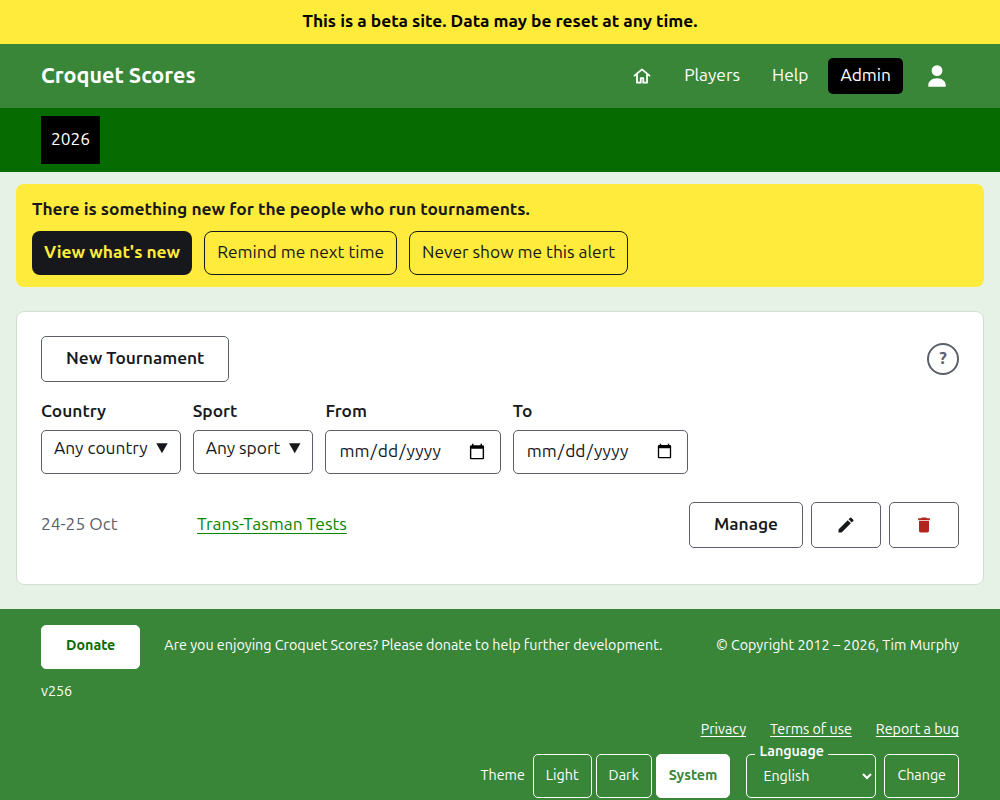
Pressing a tournament's name, or Manage, opens its page. Everything there is to run is in six tabs beneath its name: Teams, Tests, Notes, Managers, Scorers and Rankings. The Rankings tab is there only where the tournament counts toward the world rankings. The page opens on Teams, since the teams are the first thing set up.
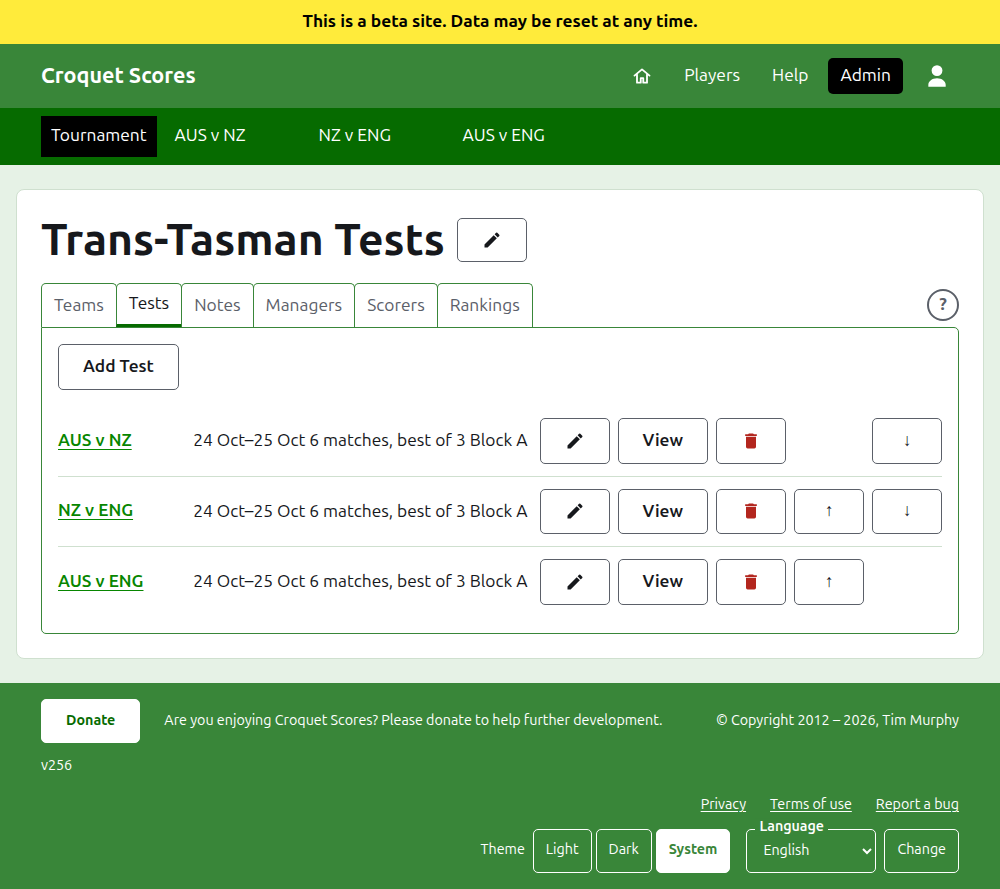
The dark green bar beneath the header is for moving between pages. On the tournament's page and on a test's page it leads to the tournament, as Tournament, and to each test by its name. On a team's page it leads to the tournament and to each team by its short name instead, since a manager on one team's page is entering players team by team. The page you are on is marked in black. When tests are added, changed, moved, archived or restored on the Tests tab, the bar follows at once.
Things that hold everywhere
Nothing is deleted outright except a note. Teams, players, tests, scores and the tournament itself are archived rather than deleted: set aside, struck through, and listed under a heading of their own, with Restore to bring them back. Archiving, restoring and moving up and down never ask you to confirm, because each is undone by pressing the other way. The things that cannot be undone, such as deleting a note or removing a manager, ask first.
A dialog over the page keeps nothing until you press its button. Cancel, or the Escape key, closes it and leaves everything as it was. Dialogs that add things, such as Add Team and Add Score, stay open after each one is added, so that a list can be typed in one after another.
What is refused is said beside the field it is about. Nothing refused is kept, and what you typed stays typed, so that it can be put right rather than typed again.
Help is a press away. A round ? is in the title bar of the page that creates or changes a tournament, at the end of the row of tabs, beside New Tournament, and in each dialog. It opens the part of this guide that is about what you are looking at, in another tab, so that what you were doing is kept.
The admin works on a phone. Every button is big enough to press with a thumb, and nothing is wider than the screen.
Next: Creating a tournament.